Scaling Intelligently: How MCP Transforms Agent Interconnectivity from Grid to Hub
The blog post discusses the inefficiency of manual integrations in agent systems, where each new agent or data source requires exponentially more connectors, creating unsustainable technical debt. Anthropic’s Model Context Protocol (MCP) addresses this by standardizing communication via a hub-and-spoke architecture. Agents interact through a single interface—listing tools, invoking tools, or reading resources—while MCP servers handle the backend. This reduces integrations from N×M (for N agents and M servers) to N+M, streamlining scalability. By decoupling agent-server communication via a unified protocol, MCP eliminates redundant point-to-point setups, simplifying deployment and maintenance. The approach shifts focus from ad-hoc integrations to protocol adherence, enabling rapid expansion of agent networks while minimizing complexity. This standardization allows systems to scale efficiently as new agents or services join, offering a pragmatic solution to the combinatorial challenges of agent-cloud interactions.
Connect three agents to three data sources by hand and you write nine integrations. Add a fourth agent and you write three more. Add a fourth data source and every existing agent needs a new connector. That math kills a roadmap before the second quarter.
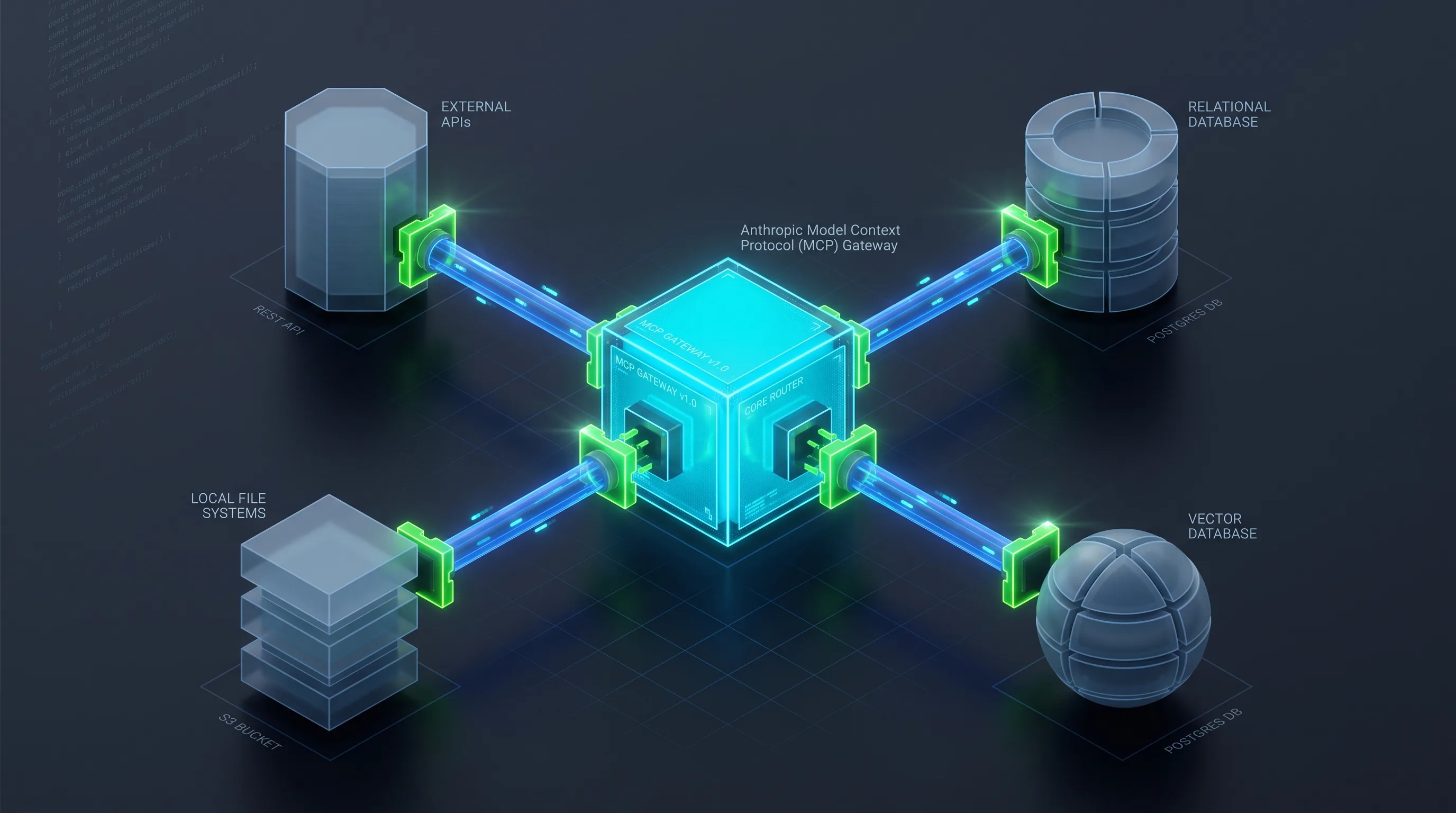
Anthropic's Model Context Protocol replaces the grid with a hub. An agent speaks one interface: list tools, call a tool, read a resource. Any MCP server behind that interface can serve any agent that knows the protocol. Wire up N agents and M servers once, and you get N + M connections instead of N × M.
The comparison

The left side is what most teams ship first: a custom client per agent, hardcoded to a specific auth flow and response shape for each source. Change the CRM's API and three agents break in three different ways. The right side puts an adapter in front of each source. The adapter speaks MCP, every agent speaks MCP, and swapping a source or adding an agent touches nothing else.
Building an MCP server
An MCP server wraps a single data source and exposes it as a small set of typed tools. This one wraps a CRM lookup and exposes a single tool:
import { Server } from "@modelcontextprotocol/sdk/server/index.js";
import { StdioServerTransport } from "@modelcontextprotocol/sdk/server/stdio.js";
import { ListToolsRequestSchema, CallToolRequestSchema } from "@modelcontextprotocol/sdk/types.js";

const server = new Server(
  { name: "crm-server", version: "1.0.0" },
  { capabilities: { tools: {} } },
);

server.setRequestHandler(ListToolsRequestSchema, async () => ({
  tools: [
    {
      name: "get_customer",
      description: "Fetch a customer record by ID",
      inputSchema: {
        type: "object",
        properties: { customerId: { type: "string" } },
        required: ["customerId"],
      },
    },
  ],
}));

server.setRequestHandler(CallToolRequestSchema, async (request) => {
  if (request.params.name !== "get_customer") {
    throw new Error(`Unknown tool: ${request.params.name}`);
  }
  const record = await crm.lookup(request.params.arguments.customerId);
  return { content: [{ type: "text", text: JSON.stringify(record) }] };
});

await server.connect(new StdioServerTransport());
Nothing in this file mentions which agent will call it, and that absence is deliberate. The support agent, the sales agent, and a debugging script written next month all reach the same tool through the same interface.
Connecting an agent to multiple servers
The agent side stays just as small. A client connects to each server, lists its tools, and merges the results into the toolset it hands to the model.
const servers = ["crm-server.js", "docs-server.js", "sql-server.js"];
const tools = [];

for (const script of servers) {
  const client = new Client({ name: "support-agent", version: "1.0.0" });
  await client.connect(new StdioClientTransport({ command: "node", args: [script] }));
  const { tools: serverTools } = await client.listTools();
  tools.push(...serverTools.map((t) => ({ ...t, client })));
}
Add a fourth server and this loop picks it up without a code change anywhere else in the agent.
Context windows: pay for what you use
MCP solves the wiring problem and creates a new one. Three servers with ten tools each hand the model thirty tool schemas before a single message arrives, and most of those schemas are irrelevant to the task at hand.
Rank tools by relevance to the current task and load only what fits a fixed budget:
def select_tools(all_tools, task_embedding, token_budget):
    ranked = sorted(
        all_tools,
        key=lambda t: cosine_similarity(t.embedding, task_embedding),
        reverse=True,
    )
    selected, used = [], 0
    for tool in ranked:
        cost = estimate_tokens(tool.schema)
        if used + cost > token_budget:
            break
        selected.append(tool)
        used += cost
    return selected
Apply the same discipline to tool output. A SQL server that returns a 400-row table wastes more context than it saves. Page the results, or summarize before returning them. Don't make the model chew through raw output on every call.
Compute cost drops with the same move. Fewer tokens per call means a smaller bill, and the savings compound across every agent hitting the server all day.
The compounding return
Teams still writing bespoke connectors per agent keep paying the N × M tax as they scale. Standardize on one protocol, and the same investment in a single MCP server pays off for every agent that shows up next.

Written by: Md. Ahmed Alif
Hello, I'm Alif! From having a passion in content writing, here I am!
Responses (0)
Sign in to commentNo responses yet.